
1.4. Applications of ODEs#
1.4.1. Kinematics#
Example 1.11
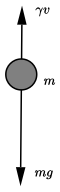
Fig. 1.1 A free falling object and the forces acting on it.#
The motion of a free falling object with mass \(m\) is given by
where \(v\) is its speed, \(g\) the gravitational acceleration, \(\gamma\) the air friction coefficient.
Find \(v(t)\) given that \(m=0.025\)kg, \(\gamma=0.007\)kg/s, \(g=9.8\) m/s2 and \(v(0)=0\)m/s.
Solution
The given equation describing the physics is a first-order linear non-homogeneous equation, we will find its analytical solution then use a numerical method to solve the problem.
Re-arrange Eq. (1.16) as
we can decompose the equations into homogeneous and non-homogenous parts
The homogeneous solution is
where \(C\) is a constant to be determined, and the non-homogeneous solution is
so the overall solution is
By using the initial condition \(v(0)=0\), we can find
and
1.4.2. Heat Transfer – Forensic Science#
Example 1.12
A forensic scientist is called to the scene of a murder. The temperature of the corpse is found to be \(75\)oF and one hour later the temperature has dropped to \(70\)oF. If the temperature of the room in which the body was discovered is a constant \(68\)oF, how long before the first temperature reading was taken did the murder occur? Assume that the body obeys Newton’s Law of Cooling,
where \(T\) is the temperature of the corpse, \(\beta\) is a constant, and \(T_R\) is room temperature. A normal body temperature for adults is generally around \(98.6\)oF (\(37\)oC).
Note: This will be a coursework question!
1.4.3. Electric Circuits#
Example 1.13
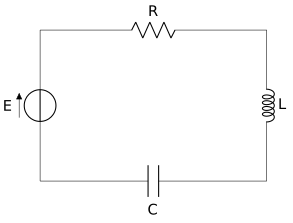
Fig. 1.2 A simple RLC series circuit.#
The current, \(I\), in a RLC circuit satisfies
Supposing \(L=1 \), \(R=5 \), \(C=\frac{1}{6}\) and \(E(t)=-10\cos t\), solve this differential equation given that \(I(0) = I'(0) = 0\) (a passive circuit).
Solution
By substituting the known conditions, the given differential equation can be simplified as
Decompose the equation into homogeneous and non-homogenous parts
For the homogeneous equation, its characteristic equation
has two distinct roots \(z_1 = -2\) and \(z_2=-3\), so the homogeneous solution is
The right hand side of the non-homogeneous is a sinusoidal function, we guess the particular solution is given by
thus its first and second derivatives are
Therefore, non-homogeneous equation is
This requires two conditions
so we get \(A=-1\) and \(B=1\).
Therefore, the particular solution is
The overall solution is
and its derivative is
Using the initial conditions \(I(0)=I'(0)=0\),
we get \(C_1=2\) and \(C_2 =-1\), so the solution is
Taking Laplace transforms of both sides:
we get
Substitute the initial conditions to obtain
Splitting into partial fractions gives
Take inverse Laplace transforms to get
1.4.4. Chemical Reactions#
Example 1.14
A chemical substance \(A\) changes into substance \(B\) at a rate \(\alpha\) times the amount of \(A\) present. Substance \(B\) changes into \(C\) at a rate \(\beta\) times the amount of \(B\) present.

Fig. 1.3 Chemical reactions of three substances.#
If initially only substance \(A\) is present and its amount is \(M\), show that the amount of \(C\) present at time \(t\) is
Solution
From the given question, we can form a system of ODEs
By using the initial condition \(A(0)=M\), we can find the solution for substance \(A\)
The equation for substance \(B\) then is
so its general solution is
by using the initial condition \(B(0)=0\), we can find the solution for substance
Thus the equation for substance \(C\) is
so we can obtain the general solution by integrating the equation
By using the initial condition \(c(0)=0\), we can find \(K_2=M\) and so the solution is
1.4.5. Population Dynamics#
Example 1.15
The population of a certain species of fish living in a large lake at time \(t\) can be modelled using Verhulst’s equation, otherwise known as the logistic equation,
where \(P(t)\) is the population of fish measured in tens of thousands, and \(\beta\) and \(\delta\) are constants representing the birth and death rates of the fish living in the lake, respectively. Suppose that \(\beta=1\), \(\delta = 10^{-3}\), and the initial population is \(N=800\). Solve this initial value problem and interpret the results in physical terms.
Solution
Using the methods of separation of variables gives
The solution to the integral on the left may be determined using partial fractions. The general solution is
Substituting the initial conditions, the solution is
Thus as time increases, the population of fish tends to a value of 1000. The solution curve is plotted in the following figure
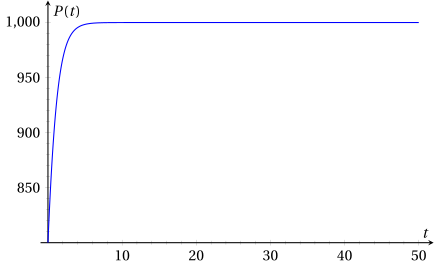
Fig. 1.4 The population of fish in a lake.#
1.4.6. Economics#
Example 1.16
The Harrod-Domar model was developed to analyse business cycles originally but later was used to explain an economy’s growth rate through savings and capital productivity. Output, \(Y\), is a function of capital stock, \(K\), \(Y=F(K)\), and the marginal productivity,
The model postulates that the output growth rate is given by
where \(s\) is the savings rate, and \(\delta\) the capital depreciation rate. The straightforward solution,
clearly demonstrates that increasing investment through savings and productivity boosts economic growth but does not take into account labour input and population size.
See Anastasios Tsoularis (2020) for more examples of ODEs in dynamic economics.