
8.1. Introduction and background#
Stiff differential equations are equations which are ill-conditioned in a computational sense. There are many definitions of the concept of stiff differential equations. The most important common feature of these definitions is that when such equations are being solved with standard numerical methods, the step size h is forced to be excessively small in order to maintain stability. This characteristic can be seen with differential equations whose solutions contain terms of the form \(e^{\lambda x}\) where \(\,\lambda\,\) is a negative number (or complex with a negative real part). The problem of stiffness is particularly enhanced when the solution consists of a transient part that decay rapidly to zero, together with another part which varies much less rapidly. Such a situations occur in a number of applications for example in chemical kinetics and in electrical circuits.
Example 8.1
Consider the differential equation
where \(\lambda \leq 0\), and \(g(x)\) is a smooth, slowly varying function. The actual solution of the equation is
Here \(\,\lambda x\,\) will soon be sufficiently negative that the first component will decay to insignificant level compared to the second. We generally can say, stiffness occurs when some components of the solution decay much faster than others.
Example 8.2
Consider the initial value problem
The solution of this initial value problem is
Analytical solution process
Rewriting the equation as
so its auxiliary (characteristic) equation is
and we get the root \(z=-40\).
Therefore the complementary (homogeneous) solution to the problem is
Now let’s try to find a particular solution to the problem
Let \(y_p = Ax+B\), and we get
so
Thus the solution to the IVP is
Substituting the initial condition \(y(0)=4\), we can get \(c=4\), therefore the overall solution to this IVP is
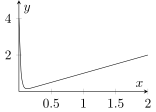
The solution consists of two parts. A slowly varying function, \(x\), and a rapidly decreasing exponential term, \(4e^{-40x}\). The diagram shows the graph of the solution.
The solution using Euler method, \(y_{j+1} = y_j + hf_j\), with various step length is shown below:
\(x_j\) |
\(y_j\) |
\(y_j\) |
\(y_j\) |
\(y(x_j)\) |
|---|---|---|---|---|
\(h = 0.1\) |
\(h = 0.05\) |
\(h = 0.01\) |
||
0.0 |
4.0000 |
4.0000 |
4.0000 |
4.0000 |
0.5 |
-971.5 |
4.5000 |
0.5000 |
0.5000 |
1.0 |
236197 |
5.0000 |
1.0000 |
1.0000 |
1.5 |
-5.7\(\times 10^7\) |
5.5000 |
1.5000 |
1.5000 |
2.0 |
1.4\(\times 10^{10}\) |
6.0000 |
2.0000 |
2.0000 |
The table shows nonsense results for \(x \geq 0.5\) except when \(h = 0.01\) is used. However, numerically this is not efficient, because a comparatively small \(h\) is begin used to approximate the function in the region which it is almost like a straight line.
To understand these results, let us examine Euler’s method when applied to the problem, i.e.
or
the general solution of this difference equation is (see Aliakbar Montazer Haghighi and Dimitar P. Mishev, 2013, Difference and differential equations with applications in queueing theory, Chapter 4),
for a fixed \(j\), \(\displaystyle\lim_{h \to 0} (1 - 40h)^j = 1\), but if \(h\) is not very small then \((1 - 40h)^j\) can be quite large for large \(j\). In fact, if \(h = 0.1\), then \(y_0(1 - 40h)^j = y_0(-3)^j\) oscillates with growing magnitude as \(j\) increases. However, only when \(|1 - 40h| < 1\) \((i.e.\ 0 < h < \frac{1}{20})\), the numerical solution resembles the real solution.
Generally, stiff differential equations arise in physical conditions due to the existence of greatly varying time constants. Time constant is the term used to refer to the rate of decay. To find the time constant for a problem consider for example the equation \(\,y' = \lambda y\,\) which has the solution \(\,Ae^{\lambda x}\,\). Interpreting the independent variable \(\,x\,\) to be time, if \(\,\lambda\,\) is negative then \(\,y\,\) decays by a factor of \(\,e^{-1}\,\) in time \(\tau\),
This is the time constant for this problem. Note that, the more negative \(\,\lambda\,\) the shorter (or the faster) is the time constant. In a problem with several components, and thus several time constants, those with the shortest time constants will control the stability of the method. Further more, the larger the magnitude difference between the time constants, the higher is the degree of stiffness.