8.3. Methods for Stiff Equations#
The above examples illustrate the problem of restriction on the value of \(\,h\lambda\,\) for the stability of stiff equations. The problem, then, is to find methods that do not restrict the step size for stability reasons.
There are special methods for which the region of absolute stability consists of all complex values of \(\,h\lambda\,\) with \(\,Real(h\lambda)<0\,\). These methods are called A-stable, and with them there is no restriction on \(h\) in order to have stability of the type we have been considering.
The most widely used class of linear multistep methods for stiff problems are called backward differentiation formulae (BDF). These methods are shown to be stiffly stable. The k-step backward difference formulae have the general form
The coefficients of \(k^\text{th}\) order \(k\)-step methods for \(k=1,2,\dots,6\) are given in the table below.
\(k\) |
\(\beta_k\) |
\(\alpha_0\) |
\(\alpha_1\) |
\(\alpha_2\) |
\(\alpha_3\) |
\(\alpha_4\) |
\(\alpha_5\) |
\(\alpha_6\) |
|---|---|---|---|---|---|---|---|---|
\(1\) |
\(1\) |
\(-1\) |
\(1\) |
|||||
\(2\) |
\(\tfrac{2}{3}\) |
\(\tfrac{1}{3}\) |
\(-\tfrac{4}{3}\) |
\(1\) |
||||
\(3\) |
\(\tfrac{6}{11}\) |
\(-\tfrac{2}{11}\) |
\(\tfrac{9}{11}\) |
\(- \tfrac{18}{11}\) |
\(1\) |
|||
\(4\) |
\(\tfrac{12}{25}\) |
\(\tfrac{3}{25}\) |
\(-\tfrac{16}{25}\) |
\(\tfrac{36}{25}\) |
\(-\tfrac{48}{25}\) |
\(1\) |
||
\(5\) |
\(\tfrac{60}{137}\) |
\(-\tfrac{12}{137}\) |
\(\tfrac{75}{137}\) |
\(-\tfrac{200}{137}\) |
\(\tfrac{300}{137}\) |
\(-\tfrac{300}{137}\) |
\(1\) |
|
\(6\) |
\(\tfrac{60}{147}\) |
\(\tfrac{10}{147}\) |
\(-\tfrac{72}{147}\) |
\(\tfrac{225}{147}\) |
\(-\tfrac{400}{147}\) |
\(\tfrac{450}{147}\) |
\(-\tfrac{360}{147}\) |
\(1\) |
For example \(k = 1\) gives the backward Euler method (or first order Adams-Moulton formula)
and \(k = 2\) gives the formula,
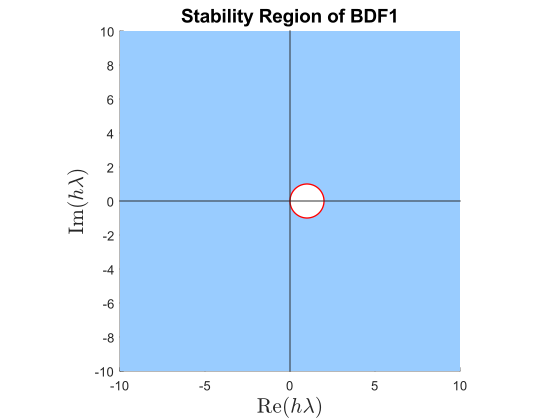
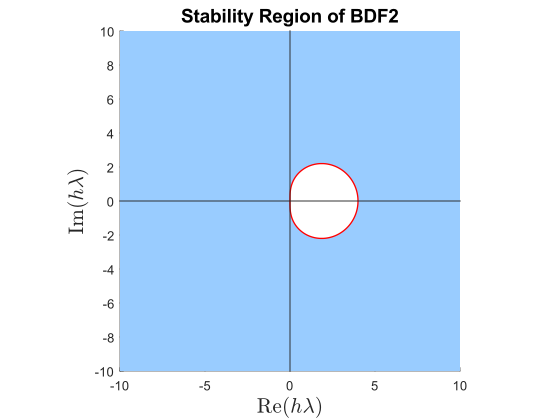
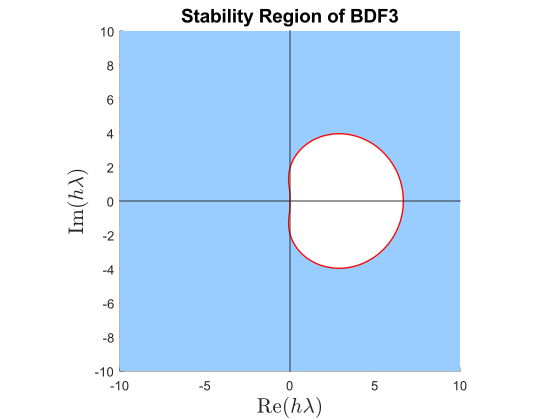
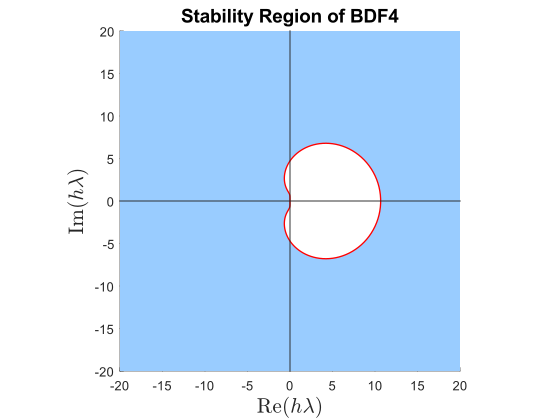
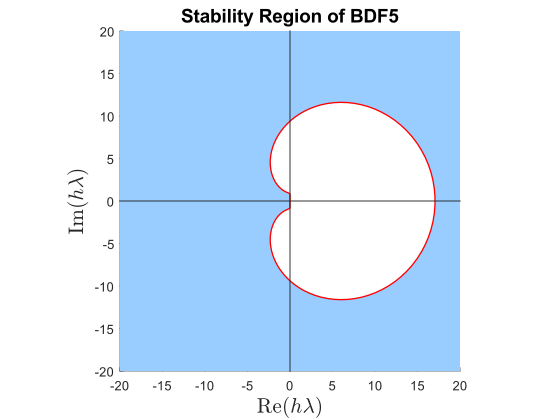
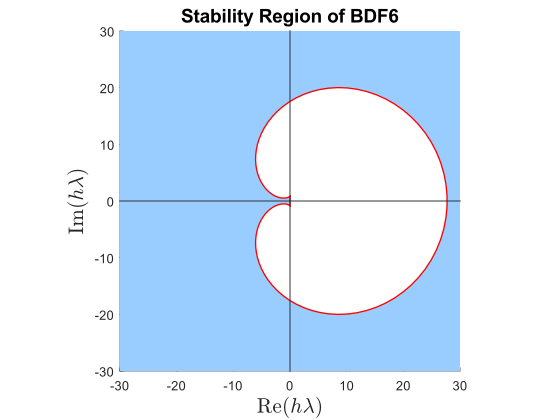
The region of absolute stability of these methods for \(k = 1,2,\dots,6\), using the Boundary Locus method are shown in the following diagram.
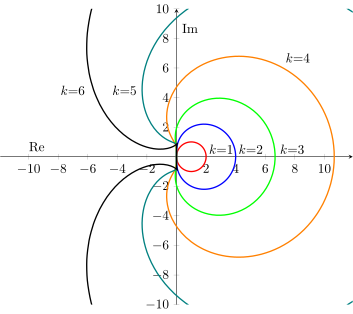
Fig. 8.1 Stability regions of BDF methods.#
Note
Note that all these methods have unbounded region of absolute stability which makes them particularly suitable for the solution of stiff problems. The detail consideration of the stability theories of these methods is outside the scope of this course and complete treatment of this topic can be found in Gear C.W. (1969), Lambert J.D. (1973) and Hairer E. and Wanner G. (1996).