
6.1. An exploratory experiment#
Example 6.1
Solve the following initial value problem
\[
y' = -y + t + 1, ~ t\in [0, 1], \quad y(0)=1
\]
by using a 2-step method given as
\[
y_n = -4 y_{n-1} + 5 y_{n-2} + 4 h f_{n-1} + 2h f_{n-2}.
\]
You should
Find the accuracy of the method;
Implement the method in Matlab/Python, and compare the numerical solution with the exact solution
\[y=e^{-t}+t.\]
6.1.1. Accuracy#
We can find the error constant of the method (see Section 5.2). Rearranging the formula as
\[
- 5 y_{n-2} + 4 y_{n-1} + y_n = h \left( 2 f_{n-2} + 4 f_{n-1} + 0 f_n \right),
\]
so
\[
\alpha_0 = -5, ~ \alpha_1 = 4, ~ \alpha_2 = 1, \quad
\beta_0 = 2,~ \beta_1 = 4,~ \beta_2=0.
\]
Using Python to calculate the error constant
import math
from fractions import Fraction

a0=Fraction(-5, 1);
a1=Fraction(4, 1);
a2=Fraction(1, 1);
a3=Fraction(0, 1);
a4=Fraction(0, 1);

b0=Fraction(2, 1);
b1=Fraction(4, 1);
b2=Fraction(0, 1);
b3=Fraction(0, 1);
b4=Fraction(0, 1);

c0= a0+a1+a2+a3+a4;
c1= (a1+2*a2+3*a3+4*a4)-(b0+b1+b2+b3+b4);
c2= (a1+2**2*a2+3**2*a3+4**2*a4)/math.factorial(2)-(b1+2*b2+3*b3+4*b4)/math.factorial(1);
c3= (a1+2**3*a2+3**3*a3+4**3*a4)/math.factorial(3)-(b1+2**2*b2+3**2*b3+4**2*b4)/math.factorial(2);
c4= (a1+2**4*a2+3**4*a3+4**4*a4)/math.factorial(4)-(b1+2**3*b2+3**3*b3+4**3*b4)/math.factorial(3);
c5= (a1+2**5*a2+3**5*a3+4**5*a4)/math.factorial(5)-(b1+2**4*b2+3**4*b3+4**4*b4)/math.factorial(4);

print("c0=",c0)
print("c1=",c1)
print("c2=",c2)
print("c3=",c3)
print("c4=",c4)
print("c5=",c5)
c0= 0
c1= 0
c2= 0
c3= 0
c4= 1/6
c5= 2/15
therefore the order of accuracy of the method is \(3\).
6.1.2. Code Implementation#
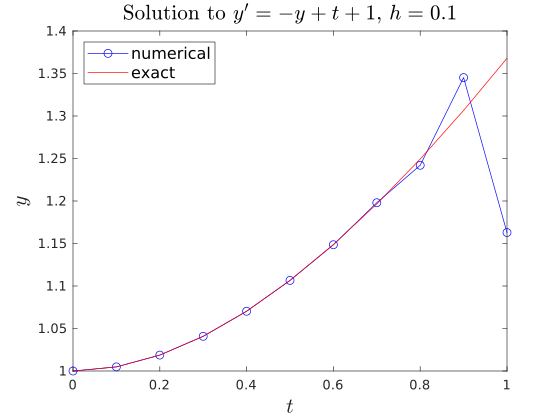
\(h=0.1\)
clear
clc
%%1-> Define the IVP
% declare an ode function (definition given at the end of the code)
f=@odeFunc;

% interval of definition
L=1;

% number of steps
nsteps=11;  %number of steps

% step size
h=L/(nsteps-1);

% initial conditions
t(1)=0.0;   %independent variable time t
y(1)=1.0;   %initial value of the dependent variable y
F(1)=f(t(1),y(1)); %calculate the value of y'=F, at t(1), y(1).

%%2-> Produce starting values
for i=2:4               %calculate the first 3 starting values using the exact solution
    t(i)=t(i-1)+h;          %calculate the next step in t
    y(i)=exp(-t(i))+t(i);   %exact solution used for calculating starting values
    F(i)=f(t(i),y(i));
end

%%3-> Apply a multistep method
for i=5:nsteps      %calculate the remaining y values using ABM 4th order method
    t(i)=t(i-1)+h;
    y(i)=-4*y(i-1)+5*y(i-2)+h*(4*F(i-1)+2*F(i-2));
    F(i)=f(t(i),y(i));
end

%%4-> Output the result
disp('  x         y          F         y_ex      AbsError');
for i=1:nsteps
    yex(i)=exp(-t(i))+t(i);
    abserror(i)=abs(yex(i)-y(i));
    fprintf('%4.2f %10.5e %10.5e %10.5e %11.6e\n', t(i),y(i),F(i),yex(i),abserror(i));
end

figure(1)
plot(t,y,'b-o',t,yex,'r-')
xlabel('$t$','Interpreter','latex','FontSize',16)
ylabel('$y$','Interpreter','latex','FontSize',16)
title("Solution to $y'=-y+t+1$, $h=0.1$",'Interpreter','latex','FontSize',16)
legend('numerical','exact','Location','northwest','FontSize',12)
% --------------------------------------------------------------------------
% Defining the ODE problem (or function) to be solved
function f=odeFunc(t,y)
    f=-y+t+1;
end
import math
import numpy as np
import matplotlib.pyplot as plt

def f(t,y):
    return -y+t+1;

#interval of definition
L=1.0;
nsteps=11;
h=L/(nsteps-1);

#declare arrays
t=np.zeros(nsteps);
y=np.zeros(nsteps);
F=np.zeros(nsteps);
yex=np.zeros(nsteps);
abserror=np.zeros(nsteps);
#initial values
t[0]=0.0;
y[0]=1.0;
F[0]=f(t[0],y[0]);

#calculate the first 3 starting values using the exact solution
for i in range(1,4):
    t[i]=t[i-1]+h;
    y[i]=math.exp(-t[i])+t[i];
    F[i]=f(t[i],y[i]);

#use multiple-step method to calculate y
for i in range(4,nsteps):
    y[i]=-4*y[i-1]+5*y[i-2]+h*(4*F[i-1]+2*F[i-2]);
    t[i]=t[i-1]+h;
    F[i]=f(t[i],y[i]);
#screen output
print(" t         y           F         y_ex      AbsError");
for i in range(nsteps):
    yex[i]=math.exp(-t[i])+t[i];
    abserror[i]=abs(yex[i]-y[i]);
    print("%4.2f %11.5e %11.5e %11.5e %11.5e" %(t[i],y[i],F[i],yex[i],abserror[i]))

#plot solution
plt.figure(1)
plt.plot(t,y,'r-o',label="numerical")
plt.plot(t,yex,'b-',label="exact")
plt.xlabel('$t$', fontsize=20)
plt.ylabel('$y$', fontsize=20)
plt.legend(loc="upper left", fontsize=14)
plt.title("Solution to $y'=-y+t+1, y(0)=1, h=0.1$",fontsize=16)
plt.yticks(fontsize=14)
plt.xticks(fontsize=14)
plt.show()
Output:
  x         y          F         y_ex      AbsError
0.00 1.00000e+00 0.00000e+00 1.00000e+00 0.000000e+00
0.10 1.00484e+00 9.51626e-02 1.00484e+00 0.000000e+00
0.20 1.01873e+00 1.81269e-01 1.01873e+00 0.000000e+00
0.30 1.04082e+00 2.59182e-01 1.04082e+00 0.000000e+00
0.40 1.07031e+00 3.29693e-01 1.07032e+00 1.260226e-05
0.50 1.10657e+00 3.93425e-01 1.10653e+00 4.404695e-05
0.60 1.14855e+00 4.51453e-01 1.14881e+00 2.646153e-04
0.70 1.19795e+00 5.02048e-01 1.19659e+00 1.366397e-03
0.80 1.24204e+00 5.57962e-01 1.24933e+00 7.290746e-03
0.90 1.34520e+00 5.54800e-01 1.30657e+00 3.863034e-02
1.00 1.16290e+00 8.37097e-01 1.36788e+00 2.049760e-01
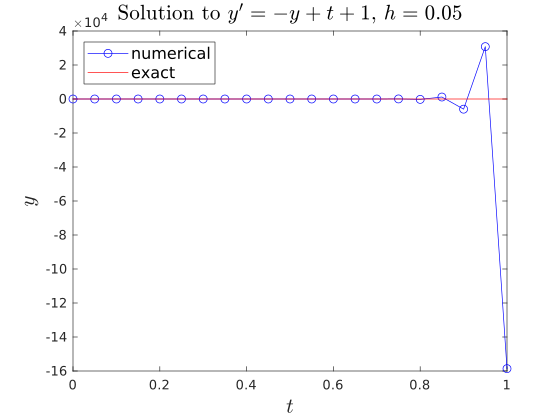
\(h=0.05\)
Output:
  x         y          F         y_ex      AbsError
0.00 1.00000e+00 0.00000e+00 1.00000e+00 0.000000e+00
0.05 1.00123e+00 4.87706e-02 1.00123e+00 0.000000e+00
0.10 1.00484e+00 9.51626e-02 1.00484e+00 0.000000e+00
0.15 1.01071e+00 1.39292e-01 1.01071e+00 0.000000e+00
0.20 1.01873e+00 1.81270e-01 1.01873e+00 9.056870e-07
0.25 1.02880e+00 2.21196e-01 1.02880e+00 2.942369e-06
0.30 1.04080e+00 2.59199e-01 1.04082e+00 1.761532e-05
0.35 1.05478e+00 2.95224e-01 1.05469e+00 8.762241e-05
0.40 1.06986e+00 3.30135e-01 1.07032e+00 4.550707e-04
0.45 1.08997e+00 3.60032e-01 1.08763e+00 2.339941e-03
0.50 1.09447e+00 4.05528e-01 1.10653e+00 1.205827e-02
0.55 1.18906e+00 3.60940e-01 1.12695e+00 6.210981e-02
0.60 8.28864e-01 7.71136e-01 1.14881e+00 3.199473e-01
0.65 2.82016e+00 -1.17016e+00 1.17205e+00 1.648116e+00
0.70 -7.29325e+00 8.99325e+00 1.19659e+00 8.489831e+00
0.75 4.49554e+01 -4.32054e+01 1.22237e+00 4.373306e+01
0.80 -2.24030e+02 2.25830e+02 1.24933e+00 2.252790e+02
0.85 1.16174e+03 -1.15989e+03 1.27741e+00 1.160464e+03
0.90 -5.97651e+03 5.97841e+03 1.30657e+00 5.977816e+03
0.95 3.07944e+04 -3.07925e+04 1.33674e+00 3.079310e+04
1.00 -1.58621e+05 1.58623e+05 1.36788e+00 1.586223e+05
Question
The 2-step looks so good, its order of accuracy is \(3\). But why it produces such significant errors in the results?