7.6. Chapter 7 Exercises#
You should try the following exercise questions first, then check with the answers.
For detailed solutions, please find them in the Moodle area for this Unit.
Exercise 7.1
Show that the method
is absolutely stable for all \(h\lambda \not\in (0,2)\).
Hint
To show that the method is absolutely stable for all \(h\lambda \not\in (0,2)\), we just need to show that the stability interval is \(h\lambda \in (-\infty, 0] \cup [2, \infty )\).
Solution to
Re-arrange the equation as
so
Thus the characteristic equation is
so
In the stability interval, it is requested that \(|z(h\lambda)|\leq 1\), so
Thus we have
which gives
therefore
the stability interval is \((-\infty, 0] \cup [2, \infty )\).
Exercise 7.2
For the method
show that
it has a stability interval of of \(\left(-\frac{4}{3},0\right)\), and
its region of stability is the circle on this interval as diameter.
Solution to
Stability interval Re-arranging the equation as
\[ y_{j+2} + 0 y_{j+1} - y_j = h \left(0 f_{j+2} + \frac{1}{2}f_{j+1} + \frac{3}{2} f_j \right) , \]so we get the characteristic equation
\[ \L (z, h\lambda) = z^2 - \frac{1}{2} h\lambda z - \left(1+\frac{3}{2} h \lambda\right) =0 \]Use Matlab to determine the stability interval (let \(H=h\lambda\) in the code)
format rat

disp(['       H           |z_1|         |z_2|']);
disp(['------------------------------------------']);
for H=-12/6: 1/6 : 6/6
    p=[1 -0.5*H -(1+1.5*H)];
    r=roots(p);
    disp([H abs(r')])
end
Output
    H           |z_1|         |z_2|
------------------------------------------
    -2           1393/985       1393/985
    -11/6         1012/765       1012/765
    -5/3         1079/881       1079/881
    -3/2         2889/2584      2889/2584
    -4/3            1              1
    -7/6         1170/1351      1170/1351
    -1            985/1393       985/1393
    -5/6            1/2            1/2
    -2/3            0              1/3
    -1/2          593/926        593/1519
    -1/3          750/943        750/1193
    -1/6         2080/2289      1087/1317
    0              1              1
    1/6          875/754        377/350
    1/3          721/550        825/721
    1/2          849/584        703/584
    2/3         1193/750        943/750
    5/6         1690/981        926/709
    1            831/449       1729/1280
Therefore, the stability interval is \(\left(-\frac{4}{3}, 0\right)\).
Stability region
The first and second characteristic polynomials are
\[ \rho(z) = z^2 - 1, \quad \sigma(z) = \frac{1}{2}z + \frac{3}{2} \]Let \(\L (z,h\lambda)=\rho(z)-h\lambda \sigma(z)=0\) and \(z=e^{\i\theta}\)
\[\begin{split} \begin{aligned} h \lambda = \frac{\rho(z)}{\sigma(z)} = \frac{z^2 - 1}{\frac{1}{2}z + \frac{3}{2}} & = \frac{2(z^2 - 1)}{z + 3} \\ & = \frac{2(e^{\i 2\theta}-1)}{e^{\i\theta}+3} \\ & = \frac{2(e^{\i 2\theta}-1)(e^{-\i\theta+3})}{(e^{\i\theta}+3)(e^{-\i\theta+3})} \\ & = \frac{2\left[-6\sin^2 \theta + \i \sin \theta (6\cos \theta +2)\right]}{10+6\cos \theta} \\ & = \frac{-6\sin^2 \theta }{5+3\cos \theta} + \i \frac{\sin \theta (6\cos \theta +2)}{5+3\cos \theta} \\ & = x(\theta) + \i y(\theta) \end{aligned} \end{split}\]Let \(y(h\lambda)=0\), we get
\[ \sin \theta = 0 \quad \text{or} \quad \cos\theta=-\frac{1}{3} \]If \(\sin \theta = 0\), then
\[x(\theta)=0 \quad \text{or} \quad y(\theta)=0\]If \(\cos\theta=-\frac{1}{3}\), then
\[ x(\theta) = \frac{-6\sin^2 \theta }{5+3\cos \theta} = \frac{-6\times(1-\frac{1}{9})}{5+3\times(-\frac{1}{3})} = - \frac{4}{3}, \quad y(\theta) =0 \]
If the stability region is indeed a circle as stated, then \(x(\theta)\) and \(y(\theta)\) should satisfy
\[ \left( x - \left(-\frac{2}{3}\right) \right)^2 + y^2 = \left(\frac{2}{3}\right)^2\]Let \(X=x - \left(-\frac{2}{3}\right)\) and \(Y=y\), we can use symbolic calculation in Matlab
syms theta
X = (-6*(sin(theta))^2 )/( 5+3*cos(theta) );
Y = (sin(theta)*(6*cos(theta)+2))/(5+3*cos(theta));
simplify((X+2/3)^2+Y^2)
Output
sym(4/9)
Use Matlab to plot the stability region
theta=linspace(0,2*pi,200)
xi=exp(1i*theta);
rho=xi.^2-1;
sig=0.5*(xi+3);
z=rho./sig;
plot(z,'LineWidth',2)
xlabel('Re')
ylabel('Im')
title('Stability Region')
axis([-1.4 0.2 -0.8 0.8])
axis('square')
xticks(-1.4:0.2:0.2)
grid
Output
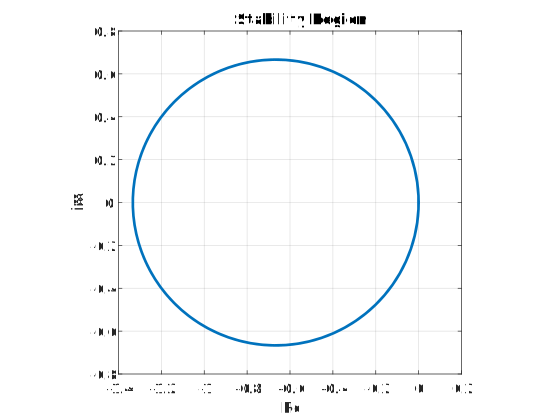
The circle crosses the real axis at \((-\frac{4}{3}, 0)\) and \((0, 0)\).
Exercise 7.3
Find the stability interval and region for the following methods:
Third-order Adams–Bashforth method \(\displaystyle y_{j+1} = y_j + \frac{h}{12}\bigl[\,23f_j - 16f_{j-1} + 5f_{j-2}\,\bigr]\)
Third-order Adams–Moulton method \(\displaystyle y_{j+1} = y_j + \frac{h}{12}\bigl[\,5f_{j+1} + 8f_j - f_{j-1}\,\bigr]\)
Solution to
Solution
Stability interval The characteristic equation is
\[ \L (z, h\lambda) = z^3 - (1+\frac{23}{12}h\lambda) z^2 + \frac{16}{12}h\lambda z - \frac{5}{12} h \lambda=0 \]Use Matlab
for H=-1:0.05:1
    p=[1 -(1+23/12*H) 16/12*H -5/12*H];
    r=roots(p)';
    disp([H abs(r)])
end
Output
    -1.0000    1.7910    0.4823    0.4823
    -0.9500    1.7018    0.4823    0.4823
    -0.9000    1.6131    0.4822    0.4822
    -0.8500    1.5248    0.4819    0.4819
    -0.8000    1.4370    0.4816    0.4816
    -0.7500    1.3498    0.4812    0.4812
    -0.7000    1.2633    0.4805    0.4805
    -0.6500    1.1773    0.4796    0.4796
    -0.6000    1.0921    0.4784    0.4784
    -0.5500    1.0076    0.4769    0.4769
    -0.5000    0.9239    0.5700    0.3956
    -0.4500    0.8410    0.6174    0.3611
    -0.4000    0.7589    0.6589    0.3333
    -0.3500    0.6775    0.6984    0.3082
    -0.3000    0.5966    0.7375    0.2841
    -0.2500    0.5161    0.7773    0.2597
    -0.2000    0.8181    0.4354    0.2339
    -0.1500    0.8605    0.3535    0.2055
    -0.1000    0.9048    0.2682    0.1717
    -0.0500    0.9512    0.1734    0.1263
     0     0     0     1
     0.0500    1.0513    0.1408    0.1408
     0.1000    1.1051    0.1942    0.1942
so the stability interval is \((-0.55, 0]\).
Stability region The first and second characteristic polynomials are
\[ \rho(z)=z^3-z^2, \quad \sigma(z)=\frac{23}{12}z^2 - \frac{16}{12}z + \frac{5}{12} \]so
\[ H = h \lambda = \frac{\rho(z)}{\sigma(z)} =\frac{z^3-z^2}{\frac{23}{12}z^2 - \frac{16}{12}z + \frac{5}{12}} \]Use Matlab
theta=linspace(0,2*pi);
xi=exp(1i*theta);
rho=xi.^3-xi.^2;
sig=(23*xi.^2-16*xi+5)/12;
z=rho./sig;

plot(z,'LineWidth',2)
axis([-1.4 0.2 -0.8 0.8])
axis('square')
grid on
xlabel('Re')
ylabel('Im')
title('Stability Region')
Output
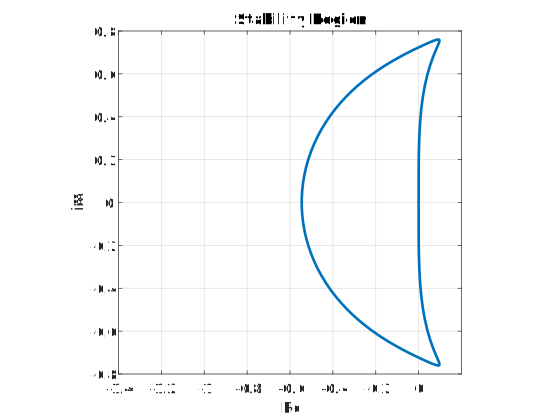
Solution
Stability interval
The characteristic equation is
\[ \L (z, h\lambda) = \left(1-\frac{5}{12}h\lambda\right)z^2 - \left(1+\frac{8}{12}h\lambda\right)z + \frac{1}{12} h \lambda =0 \]Use Matlab
for H=-10:0.5:1
    p=[(1-5/12*H) -(1+8/12*H) H/12];
    r=roots(p)';
    disp([H abs(r)])
end
Output
   -10.0000    1.2281    0.1313
    -9.5000    1.2078    0.1322
    -9.0000    1.1858    0.1332
    -8.5000    1.1618    0.1342
    -8.0000    1.1355    0.1355
    -7.5000    1.1066    0.1369
    -7.0000    1.0747    0.1386
    -6.5000    1.0394    0.1405
    -6.0000    1.0000    0.1429
    -5.5000    0.9558    0.1457
    -5.0000    0.9059    0.1492
    -4.5000    0.8492    0.1536
    -4.0000    0.7844    0.1594
    -3.5000    0.7096    0.1672
    -3.0000    0.6228    0.1784
    -2.5000    0.5220    0.1955
    -2.0000    0.4058    0.2240
    -1.5000    0.2774    0.2774
    -1.0000    0.3872    0.1519
    -0.5000    0.6084    0.0567
     0     0     1
     0.5000    1.6524    0.0319
     1.0000    2.8062    0.0509
so the staiblity interval is \([-6, 0]\).
Stability region
The first and second characteristic polynomials are
\[ \rho(z) = z^2 - z, \quad \sigma(z) = \frac{5z^2 + 8 z - 1}{12} \]Use Matlab
theta=linspace(0,2*pi,200);
xi=exp(1i*theta);
rho=xi.^2-xi;
sig=(5*xi.^2+8*xi-1)/12;
z=rho./sig;

plot(z,'LineWidth',2)
axis([-7 1 -4 4])
axis('square')
grid on
xlabel('Re')
ylabel('Im')
title('Stability Region')
Output
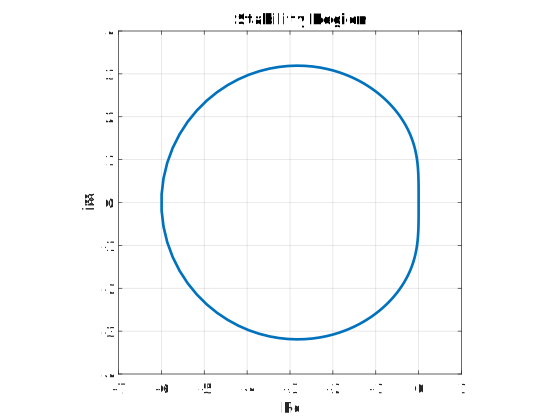
Exercise 7.4
Show that the method
has an interval of absolute stability of \((-\infty,0]\). Explain how you can verify your results.
Solution to
The characteristic polynomial is
To ensure
we should let
therefore, the stability interval is \((-\infty, 0]\).
Exercise 7.5
Show that the Simpson’s rule:
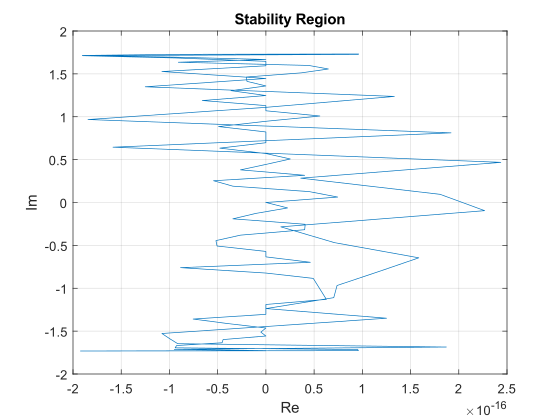
has no interval of absolute stability. Try to verify your results by plotting the region of absolute stability.
Solution to
Re-arrange the equation
The characteristic equation
Let \(H=h\lambda\)
Matlab code
format short
for H=-5:0.5:1
    p=[(1-H/3) (-4/3*H) -(1+H/3)];
    r=roots(p)';
    disp([H abs(r)]);
end
Output
   -5.0000    2.3956    0.1044
   -4.5000    2.3136    0.0864
   -4.0000    2.2214    0.0643
   -3.5000    2.1175    0.0363
    -3     0     2
   -2.5000    1.8669    0.0487
   -2.0000    1.7165    0.1165
   -1.5000    1.5486    0.2153
   -1.0000    1.3660    0.3660
   -0.5000    1.1779    0.6064
     0     1     1
    0.5000    1.6490    0.8490
    1.0000    2.7321    0.7321
From the output we can see that the modulus of one root is alway larger than \(1\), so the method has no stability interval.
Now let’s have a look at the stability region
Matlab code
theta=linspace(0,2*pi);
xi=exp(1i*theta);
rho=xi.^2-1;
sig=(xi.^2+4*xi+1)/3;
z=rho./sig;
plot(z)
xlabel('Re')
ylabel('Im')
title('Stability Region')
grid on
Output