9.3. Matrix Sparsity and Graph Theory#
A graph \(G = \{v,E\}\) consists of a set of vertices \(v\text{(nodes)}\) and a set of edges \(E\) connecting the vertices. A graph can be used to represent the nonzero pattern of a sparse matrix. Any symmetric sparse matrix can be represented by a graph \(G\) where there is an edge from vertex \(i\text{(row)}\) to vertex \(j\text{(column)}\) and a letter or symbol represents the nonzero entry, e.g. \(a_{ij}\).
Associated with each graph is an adjacency matrix \(A = (a_{ij})\):
The degree of a node in a graph is the number of nodes adjacent to it (or the number of edges connected to it).
Example 9.1
Consider the following matrix \(A\) and its corresponding adjacency graph.
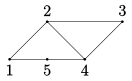
The following MATLAB .m file produces the adjacency graph of matrix A:
%Example 1 - Adjacency graph using gplot function
A=[1 1 0 0 1;1 1 1 1 0;0 1 1 1 0;0 1 1 1 1;1 0 0 1 1];
% Enter the Cartesian coordinates for the vertices
xy=[1 1; 2 2; 5 2; 4 1; 3 1];
gplot(A,xy,'k-*');% marking the elements using * in black font
axis([0 6 0 3]);
text(1,0.9,'1');
text(2,2.1,'2');
text(5,2.1,'3');
text(4,0.9,'4');
text(3,0.9,'5');
Example 9.2
Consider the following matrix \(A\) and its corresponding adjacency graph.
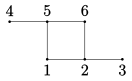
%Example 2 - Adjacency plot
A=[1 1 0 0 1 0;1 1 1 0 0 1;0 1 1 0 0 0;0 0 0 1 1 0;
    1 0 0 1 1 1; 0 1 0 0 1 1];
xy=[2 1;3 1;4 1;1 2;2 2;3 2];
gplot(A,xy,'k-*');
axis([0 5 0 3]);
text(2,0.9,'1');
text(3,0.9,'2');
text(4,0.9,'3');
text(1,2.1,'4');
text(2,2.1,'5');
text(3,2.1,'6');
%End
In MATLAB the function spy plots the sparsity pattern (i.e. the non-zero elements) of any matrix A.
Example 9.3
Enter the matrix A in MATLAB
>>   A=[1 0 2 3 0
        0 0 0 5 0
        0 1 0 0 8
        1 0 0 0 4
        0 0 6 7 0]
>> spy(A)
MATLAB will produce the sparsity pattern (nonzero elements) for matrix \(A\) as:
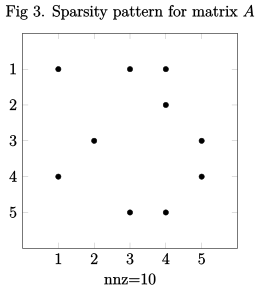
The number of nonzero elements in matrix \(A\) is \(10\) and this is noted by \(nnz=10\) in Fig. 3.
Example 9.4
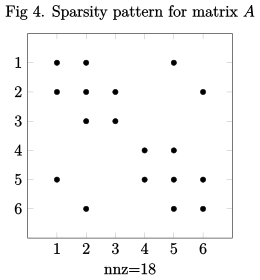
Define the matrix \(A\), from Example 2, in MATLAB, followed by the command spy(A), gives:
>>   A=[1 1 0 0 1 0
        1 1 1 0 0 1
        0 1 1 0 0 0
        0 0 0 1 1 0
        1 0 0 1 1 1
        0 1 0 0 1 1]

>> spy(A)